Review by Tori Bissonette
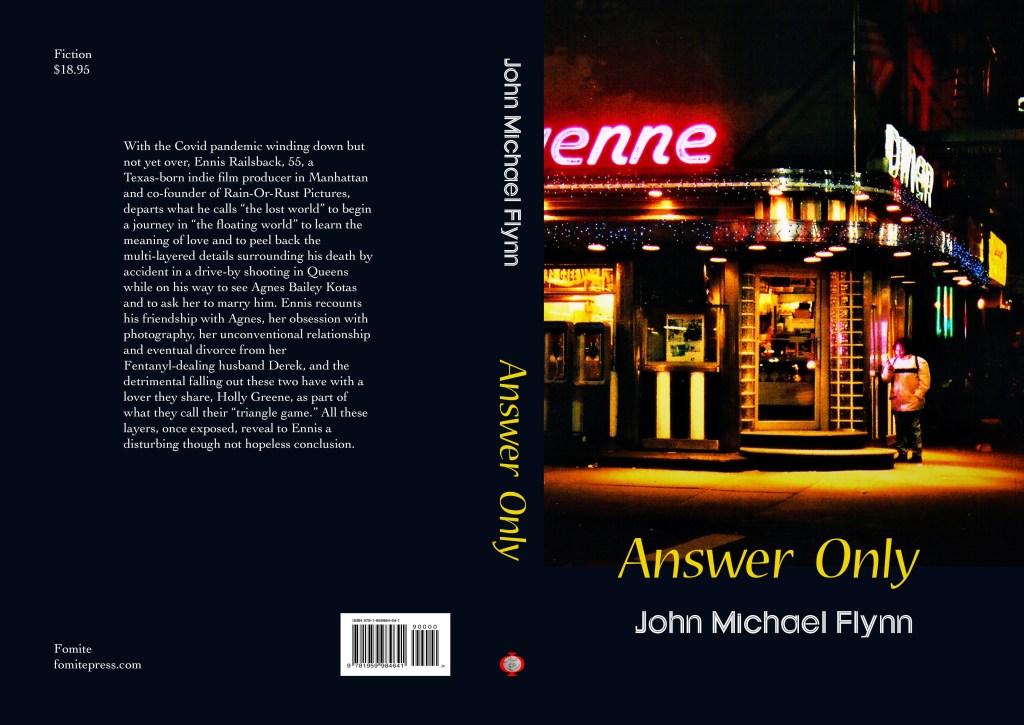
Answer Only opens with a bang—a gunshot to be precise. Our narrator, Ennis Railsback, a man as pretentious as his name would suggest, is murdered on the first page, in the first sentence even. The rest of the novel unfolds from beyond the mortal plane as Ennis reflects on the people most relevant to his life at the time of his passing.
It’s the dynamics between the characters from Ennis’s past that bring life to the novel. This story unfolds through the slow implosion of a bizarre polyamorous relationship, referred to as “the triangle game,” and the budding romance between Ennis and Agnes, whose age gap is significant enough to be compared to a father-daughter relationship throughout. The indecisive ups and downs between characters are realistic and complex, being told through the differing perspectives of all parties involved.
And yet, despite this unique premise of Ennis’s early death, the novel doesn’t quite live up to its high-tension opener. That our narrator is deceased is only relevant in the last twenty or so pages, and only then because the timeline moves from pre- to post-death. Prior to that, Ennis’s thoughts are no different than any living man reflecting back on his life thus far. Ostensibly, a frame narrative is set up in which Ennis is privy to the private thoughts of his friends, primarily his love interest Agnes, Agnes’s husband Derek, and their mutual lover Holly. Ennis explains, almost half way through the novel, that he, being now “unshackled from the lost world,” is privy to the innermost thoughts of his friends and he is conveying their thoughts to us. Yet there’s very little conveyed that wouldn’t be the same if the book simply switched narrator every few chapters. Ennis as a lens for the audience has little impact, instead relaying other characters’ perspectives as a regular third person narrative. In execution, the unique narrative structure doesn’t add much.
The novel focuses heavily on character and culture analysis. Much of the page space is given to the internal musings of our main characters, which creates an experience not unlike visiting older relatives for the holidays who want to lament the world today and their own missed opportunities. In this way, it functions as a memoir, organized thematically with touchpoints of action. As long as you begin with that understanding, then this novel holds much to be considered. The topics are aggressively contemporary—the fentanyl crisis, George Floyd, President Trump, bipartisan politics, gender fluidity, and the effects of the pandemic—but they’re presented from multiple perspectives, which gives the reader a broad lens. For me personally, it was too soon to have any desire for a pandemic story reflecting on the personal and societal impacts of extended isolation, but in a few years, Flynn’s work will be a perfect time capsule of the current zeitgeist. The most emblematic scene of this philosophy-over-action approach is a scene in which a character passes by a potential mugger. This moment of suspense between suspecting she’ll be mugged and the mugger taking action one way or another, spans about five pages of her considering the societal factors that brought them both to that moment. That’s what this story does–it pulls those moments of conflict and decision apart and revels in the unanswerable bits left behind.
This isn’t a page turner to rush through, but a thought piece to ruminate on every time you have to set it down. The ideological foundations will engage readers looking for philosophical considerations of the contemporary world. In that, Answer Only excels.
For more information about John Michael Flynn’s Answer Only, head on over to Fomite Press. You can purchase your copy of Answer Only by clicking this link!
 For Page & Screen