Review by Tori Bissonette
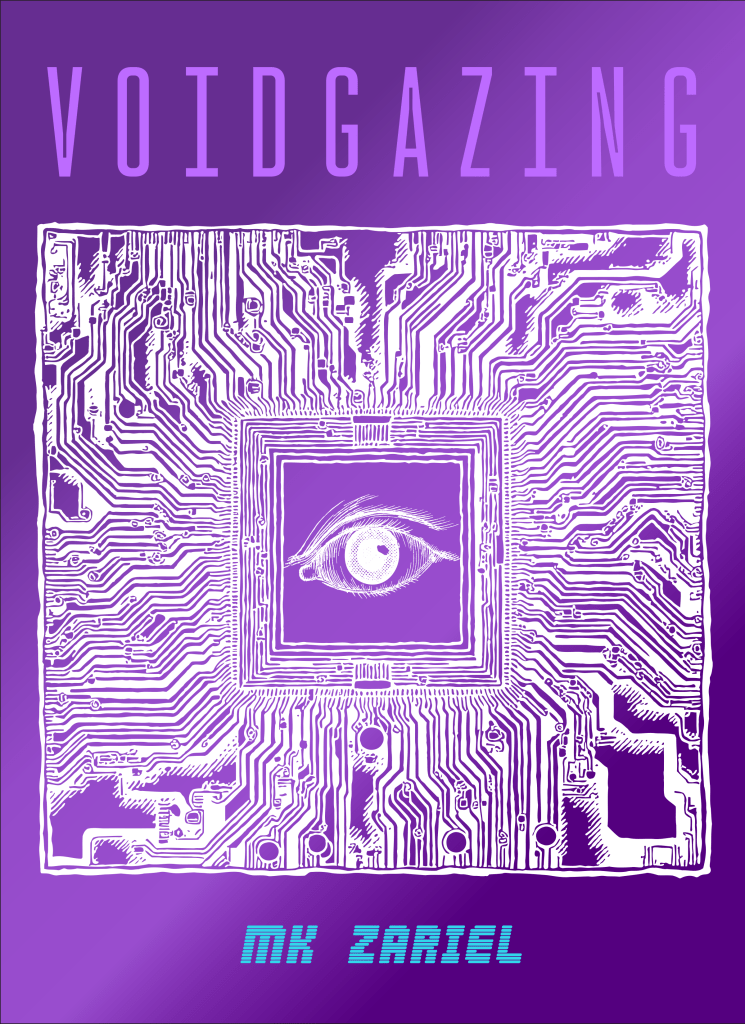
VOIDGAZING by mk zariel is a collection of nine poems, all lowercase, that examine our (dis)connection in today’s hyperfast, hyperdigital world. Contemporary life is disassembled into micromoments—memes, social media feeds, and group chats—and navigated with a wry humor and a relatable sensitivity. The speaker is fraught with contradictions, alone yet connected.
“every social feed” was a particular strong point for me, exploring the whiplash of being bombarded with news both wonderful and terrifying, local and global, at any given moment and the dulling effect it can have on our emotions. This theme of how our emotional bonds evolved with—alongside and against—the development of technology is echoed throughout many of the poems, but there’s still space for hope and connection beneath the anger and isolation.
“on learning there are only two genders” lightens the tone with a light-hearted approach to gender and identity politics. The speaker is gritty and fab in the best way, approaching gender without the restraints we’re used to seeing toted along with gender. In this piece, we see a development of the self that’s more confident, while other poems drip with self-doubt and a painful awareness of the fleeting nature of connection. This relation between self-identity and the communities around us, both positive and negative, underpins the entire collection.
The language mk zariel uses in this collection is approachable, almost nihilistic at times, despite the profound emotional implications, and the contemporary nature of the situations discussed make this collection both accessible and rewarding. You don’t need meticulous study to understand or to appreciate them, but there is meaning to be had that goes beyond the words on the page. This collection is a testament to evolution, pitfalls and all. Evolution of ourselves, our relations, and our digital touchpoints. “i am a constellation of spellchecks / of self-editing of becoming stopped in her tracks”; aren’t we all.
Interview with mk zariel, author of VOIDGAZING
Form, and at times a lack of form, plays such a large role in the power of these poems. Can you share about your thought process in deciding how a poem should look and be structured on the page?
When I write poetry, I enjoy making it look like an intentional subversion of order—using punctuation artisticly rather than according to grammar rules, rejecting the prosaic compulsion to capitalize words solely because of where they are in a sentence, and even challenging my prexisting assumptions about spelling and spacing. I do this because much of our reading life is pretty aesthetically cohesive; the content of different texts is wildly different, but their visual look is rather similar, with left-aligned text, one-inch margins, black twelve-point font, spacing, capitalization, and all the rest. When we read poetry, it can be generative to see something that subverts those norms; it means that our expectations have already been challenged visually, that we might be more open to having them challenged intellectually. I find Robert Anton Wilson’s concept of chapel perilous—that is, an experience where one feels that one’s sense of objective reality is called into question—really resonant here; to engage with art and literature, we need this kind of defamiliarization, and an unusual form can contribute to that. That said, form is not a focus for me when I write, in that I do all my revising aloud and change words based on how it feels to perform my poetry, not how it looks visually on the page, so it is by no means a focus for me.
Can you tell us about your decision to share the title of the poem “voidgazing” with the collection at large?
I am in the otherkin community and find void/abyss imagery resonant in terms of how I experience my own gender and body, but beyond that, I believe that the way we concieve of the void is at once destructive and generative. When we think of voids, we think of liminal spaces, black holes, pockets where light and energy go to die—but we also think of space that can be filled, of the urge to create and destroy, of what Renzo Novatore calls the creative nothing. This duality speaks to how I experience technology; it is a tool for state power, surveillance, and vitriolic comments, but also enables the community building and translocal connection that sustains our subcultures and movements. VOIDGAZING, to me, means the act of looking at technology without the illusion that it is all-liberating or inherently harmful. As Evan Greer once put it in an interview, technology is a force multiplier for power.
Is there anything specific you’d like your readers to take from this work?
I would like readers to feel a sense of possibility and openness; the thesis of my work is not that technology will liberate us all, but rather that we as queers and anarchists have an opportunity to use it in liberatory ways. If you read VOIDGAZING and come away wanting to start an affinity group or write a DIY zine or bail out an incarcerated community member or set up a donation to a Palestine solidarity effort or mentor a trans kid or distribute free food in your community or even just support a friend who needs it, then I’ve done my job. Poetry is here to inspire us to action, to comfort us through times of repression, and to provide a source of beauty for beauty’s sake—and that is all I want for my work.
Here at For Page & Screen, we’ve had the privilege of publishing your script, “The Museum of Disappointing Transmascs”; can you tell us a bit about how you came to work in multiple different forms?
Theater and poetry are not seperate art forms for me; I’ve participated in both since my middle school years, both writing for theater and acting in it, as well as writing and performing poetry. All of my poetry is meant to be read aloud, and I almost exclusively revise by performing my work; my interest in playwriting (and one ill-fated attempt at screenwriting, the results of which I will not share here) comes from a desire to write something more character-driven, without the limitation of my poems usually being in first-person and having one specific speaker. That said, I see the characters in my plays as poets in their own right; they have monologues, nonlinear dialogue, scenes that show their external experiences rather than interactions with other characters. There is certainly theater out there with a prosaic, conversational vibe, and my scripts sometimes lean toward that, but the poetic influence is also there much of the time.
Do you have any other events or news you’d like to share?
Yes! I have book events coming up for all three projects; my website (https://mkzariel.carrd.co/) is the best source for up-to-date info.
For more information about mk zariel’s VOIDGAZING, head on over to the author’s website or purchase your copy of VOIDGAZING from Whittle Micro-Press, available May 14th 2026!
An ARC of VOIDGAZING was provided by the author for this review.

