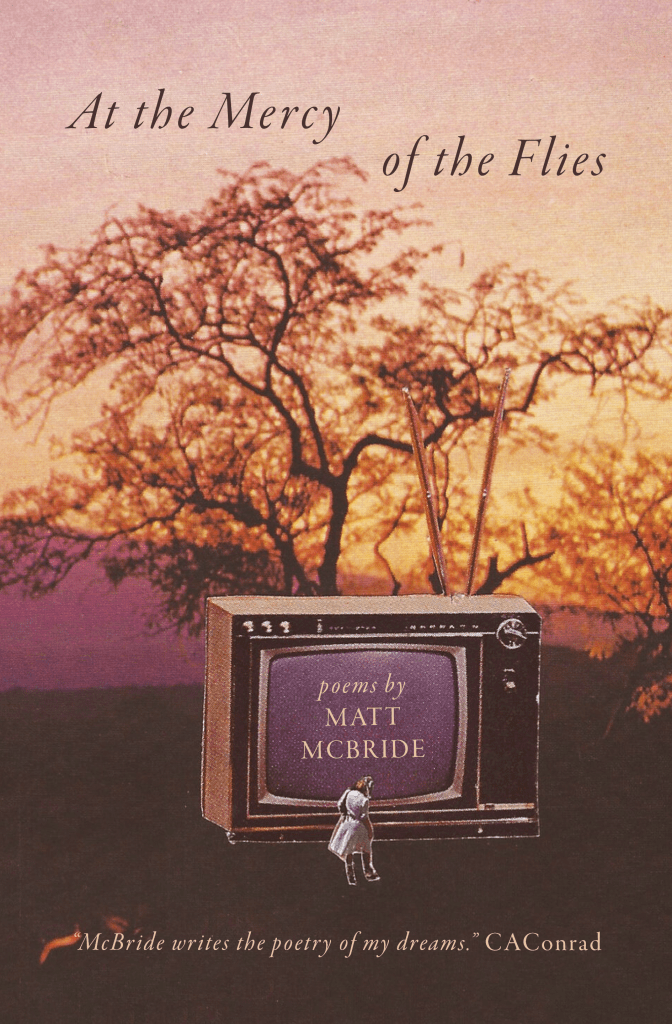
“At the Mercy of the Flies renders the mundanity of daily life as a series of dislocations. What emerges is a record of survival written in the margins of collapse. Anchored in the author’s experiences with depression and the aftermath of the 2016 presidential election, these poems chart the cartographies of a life and a nation in freefall. No party lasts forever—not even America.”
At the Mercy of the Flies by Matt McBride is a surreal and timely collection of poems that offers the reader seemingly disconnected imagery but leaves us with a lasting sense of emotional connection and (mis)understanding. Written primarily using successive short stanzas, McBride takes a unique perspective on everyday life that manages to feel like a dream but also like the perfect embodiment of life when reality itself becomes too overwhelming to describe in any more common way.
The rhythm and the consistent structure of each piece within the collection allows everything to be read smoothly and helps to add to that almost “fever dream” atmosphere that pervades the work itself. On my own first read of this book, I read the entire collection in one sitting, enjoying the way the structure of the work made each piece feel both disjointed and endless. That contradiction is just one of several that is echoed in other parts of the text—but we’ll talk about those later on.
With that said, I do want to mention my personal favorite moment in the collection because it makes a point to break these expectations in terms of structure. Beginning with the line “White hair rained,” there is a page in “The Mourners Forgot Which Funeral They Were At” where McBride shifts from the short separated stanzas to almost an entire page of text. Visually, the shift clues us in to the importance of the page and the contrast between the amount of text and the short snappy sentences actually within it creates a fantastic shift in terms of tone and pacing. It stands out because it breaks us from the standard that’s already been established and, personally, I’d say it’s my favorite moment of the book because of the risk it takes to do so.
In terms of form and expectations, I will say the actual visual structuring of works within this book did leave some room for confusion on my first read. The book itself is divided into three pieces, “The Mourners Forgot Which Funeral They Were At,” “The Age of,” and “The Party,” but in the Notes at the end of the text it is clear that a handful of pages within each section were published as individual poems rather than as the larger pieces we see in this book. The pages also offer large sections of blank space that lead the reader to think, at a glance, of each page as an individual poem, which I admit created a bit of ambiguity and confusion for me on my first read through.
This ambiguity, however, fits well with the poetry itself and I imagine it was a conscious choice by the author. There are so many recurring themes and images throughout this text that, even if you sit with the discomfort the space between the text can bring, everything feels unified and cohesive. It’s those same motifs that really work wonderfully to pull through the emotions and moments of commentary held throughout this book. There’s an element of distance—whether through the vehicle of dreams in “The Mourners Forgot Which Funeral They Were At,” the importance of taxonomy that seems to underly “The Age of,” or the return to artificiality (Christmas lights, Easter grass, plants, mannequins, etc.) in “The Party”—that carries through this book in a fascinating and complex way.
The distance, in its own way, speaks to a want of connection that I felt while reading through these poems. The speaker in each section is full of contradictions such as wanting connection and reality while focusing on dreams and actively struggling to connect with the people around them. The shifting between “I” and “We” from section to section speaks to this in a way that is subtle, effective, and, at times—specifically when thinking of “The Age of”—even accusatory. Similarly, the speaker’s relationship to softness is one I found particularly interesting. In the final section of the book I was particularly struck by these lines:
“The soft meaninglessness

of clouds
stuffed the unstuffed space.

And when we ran out of confetti,
we used broken glass.”
These lines seem to embody this simultaneous disdain and desire for softness that mirrors the complex feelings of grief, guilt, love, and yearning that carry through this book. While much of the imagery itself throughout this text leans more into the sphere of critical commentary, it was those very real human emotions that I felt made this collection sing.
Overall, I found At the Mercy of the Flies by Matt McBride to be a complex, contradictory, and surreal collection of poems both timely and, for me, relatable on a deeper emotional level. There are layers here that lead me to think this book is one I’ll appreciate more the more times I read it. If you’re looking for a book to return to again and again, At the Mercy of the Flies might just be the one for you!
For more information on Matt McBride’s At the Mercy of the Flies, or to purchase your own copy, head on over to Half Mystic Press!
A digital copy of At the Mercy of the Flies was provided by Half Mystic Press for this review.

