Guest post by Amir Zadnemat
In the cinema of Yasujirō Ozu, stasis and his characteristic low camera position do more than frame family stories. They give expressive weight to restrained bodies, minimal gestures, and carefully organized spaces, allowing questions of social change, temporality, and human attachment to emerge through cinematic form. Seated postures, fleeting gazes, pauses, and silences become signs of vulnerability, hesitation, endurance, and emotional restraint. Through these formal strategies, Ozu develops a cinematic language in which stillness and spatial distance invite ethical and philosophical reflection on everyday existence.
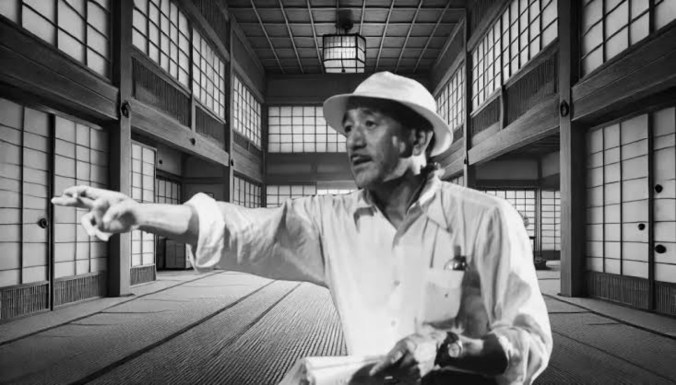
Gilles Deleuze’s discussion of Ozu in Cinema 2: The Time-Image provides a productive framework for understanding the relationship between stillness and temporality in his cinema. Deleuze places Ozu within his account of pure optical and sound situations, in which the sensory-motor link becomes weakened and perception is less directly subordinated to action. Ozu’s predominantly static shots, restrained compositions, and contemplative images therefore do not simply interrupt narrative movement; they can make duration and temporal experience more perceptible. Stasis, in this sense, is not merely the absence of movement but a formal condition through which time can be experienced differently.
Stasis in Ozu extends beyond bodily immobility. The placement of bodies within the frame, the distances between them, and the geometric organization of domestic space all contribute to the production of meaning. In Late Spring (1949) and Tokyo Story (1953), low framings, horizontal and vertical lines, pauses, and carefully measured movements give visual weight to seemingly minor gestures. These formal elements can register the pressures of social transformation without reducing them to explicit dramatic conflict. Rather than presenting social change primarily through confrontation, Ozu allows its effects to become perceptible through the organization of everyday life.
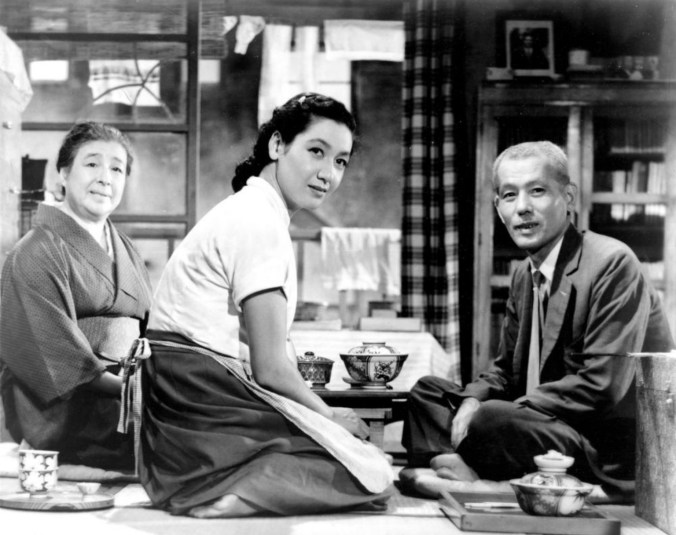
In Late Spring, the stillness surrounding Noriko and her widowed father, Professor Shukichi Somiya, is closely connected to questions of marriage, family responsibility, and separation. Noriko’s situation cannot be reduced simply to a conflict between tradition and modernity. Rather, the film presents attachment, obligation, and individual choice as values that may become difficult to reconcile. Ozu’s restraint allows this tension to emerge through pauses, glances, spatial distance, and ordinary routines rather than through sustained confrontation. The apparent calm of the characters thus conceals an intense process of emotional and ethical negotiation. The ethical dimension of this situation lies not in the film’s offering a definitive moral judgment, but in its sustained attention to the competing claims of attachment, responsibility, and individual desire.
Ozu’s treatment of empty spaces and objects further extends this logic of stasis. The expression “pillow shot” is particularly associated with Noël Burch’s critical writing on Ozu, while Donald Richie’s writing helped establish the critical vocabulary of Ozu’s “still lifes.” Although these concepts overlap, they should not be treated as interchangeable. Deleuze brings Burch’s “pillow-shots” and Richie’s “still lifes” into his broader discussion of Ozu’s treatment of empty spaces, landscapes, objects, and stasis, while distinguishing their different functions. Such images can suspend the immediate progression of narrative action and redirect attention toward duration, absence, and the persistence of an emotional situation beyond the event itself. They should therefore not be treated merely as decorative interruptions. Their significance lies partly in the way they alter the spectator’s experience of cinematic time and shift attention from what happens to the temporal and affective conditions surrounding what happens.
Domestic space is equally important. Walls, windows, corridors, doorways, and everyday objects are not neutral backgrounds but active components of Ozu’s visual system. They establish distances, divisions, and forms of proximity through which relationships become perceptible. The low camera position, often described in Ozu scholarship as the “tatami shot,” is commonly associated with the approximate height and spatial orientation of a person seated on a tatami floor. It should not, however, be reduced to a literal reproduction of a seated viewer’s point of view. Rather, the so-called tatami shot forms part of Ozu’s broader system of low-height framing, compositional balance, spatial continuity, and architectural geometry. Its significance emerges not simply from camera height but from the way that height interacts with the organization of domestic space and the placement of bodies within it.
Paul Schrader’s account of Ozu as an instance of “transcendental style” offers another important point of reference for understanding this formal restraint. Yet Ozu’s stillness need not be interpreted as a direct rejection of modernity or as a form of political resistance. His films instead create a contemplative distance from which the effects of social transformation become perceptible through ordinary relationships and routines. In Tokyo Story, for example, generational distance, work, urban life, and changing family structures are experienced less through overt conflict than through waiting, separation, displacement, and the gradual recognition of emotional absence. The film’s restraint does not eliminate social tension; it relocates that tension within everyday gestures, routines, and forms of spatial and emotional distance.
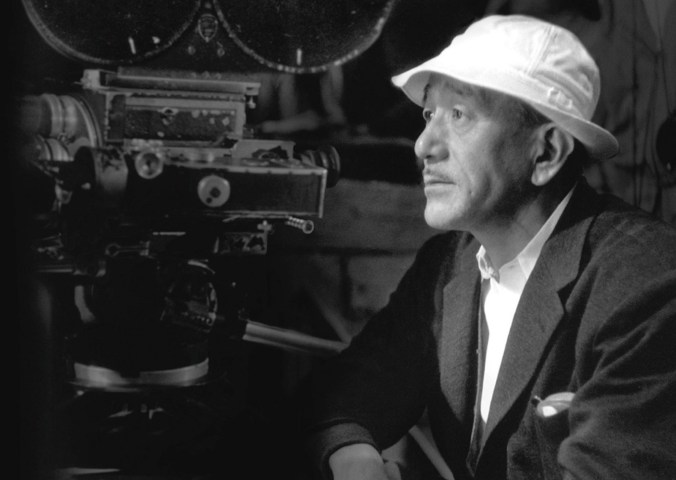
Stasis consequently becomes an active form of cinematic expression. The still body is not necessarily passive: beneath its outward calm may lie hesitation, affection, anxiety, resignation, resistance, or moral uncertainty. A gesture acquires significance precisely because its external simplicity contrasts with its emotional consequences. Likewise, an empty room or an apparently incidental object may retain the temporal and affective traces of an event that has already occurred. In this sense, stasis creates a space for spectators to attend to experiences that conventional dramatic action might render secondary or invisible.
Ozu’s stasis is therefore not simply a cessation of movement. It is a formal means through which time, relationships, and change become perceptible. By reducing overt action and allowing bodies, spaces, pauses, and objects to occupy the spectator’s attention, Ozu creates a cinema in which ethical questions emerge without definitive answers. His films do not simply explain loss, obligation, attachment, or transformation; they make these experiences perceptible through duration, spatial organization, and the careful distribution of attention. The spectator is not instructed how to judge these experiences but is given time to encounter their ambiguity.
The silent body in Ozu is consequently more than an image of passivity. It is a site where social pressure, emotional experience, temporal duration, and ethical reflection converge. Stillness does not eliminate movement from Ozu’s cinema; rather, it changes the conditions under which movement, time, and human relationships can be perceived. By making small gestures, spatial distances, and moments of silence formally significant, Ozu transforms ordinary situations into sites of sustained reflection. His cinema suggests that ethical experience may emerge not only through decisive action or explicit conflict, but also through the patient perception of vulnerability, attachment, separation, and change.
About the Author
Amir Zadnemat holds a master’s degree in Literature from the University of Guilan. He began developing his writing through participation in national academic conferences and publication in emerging literary magazines. Over the past several years, he has pursued writing professionally, with his work appearing in a range of literary and film-focused publications.

